Voices of Hope and the Growing Debate Over Public Accountability
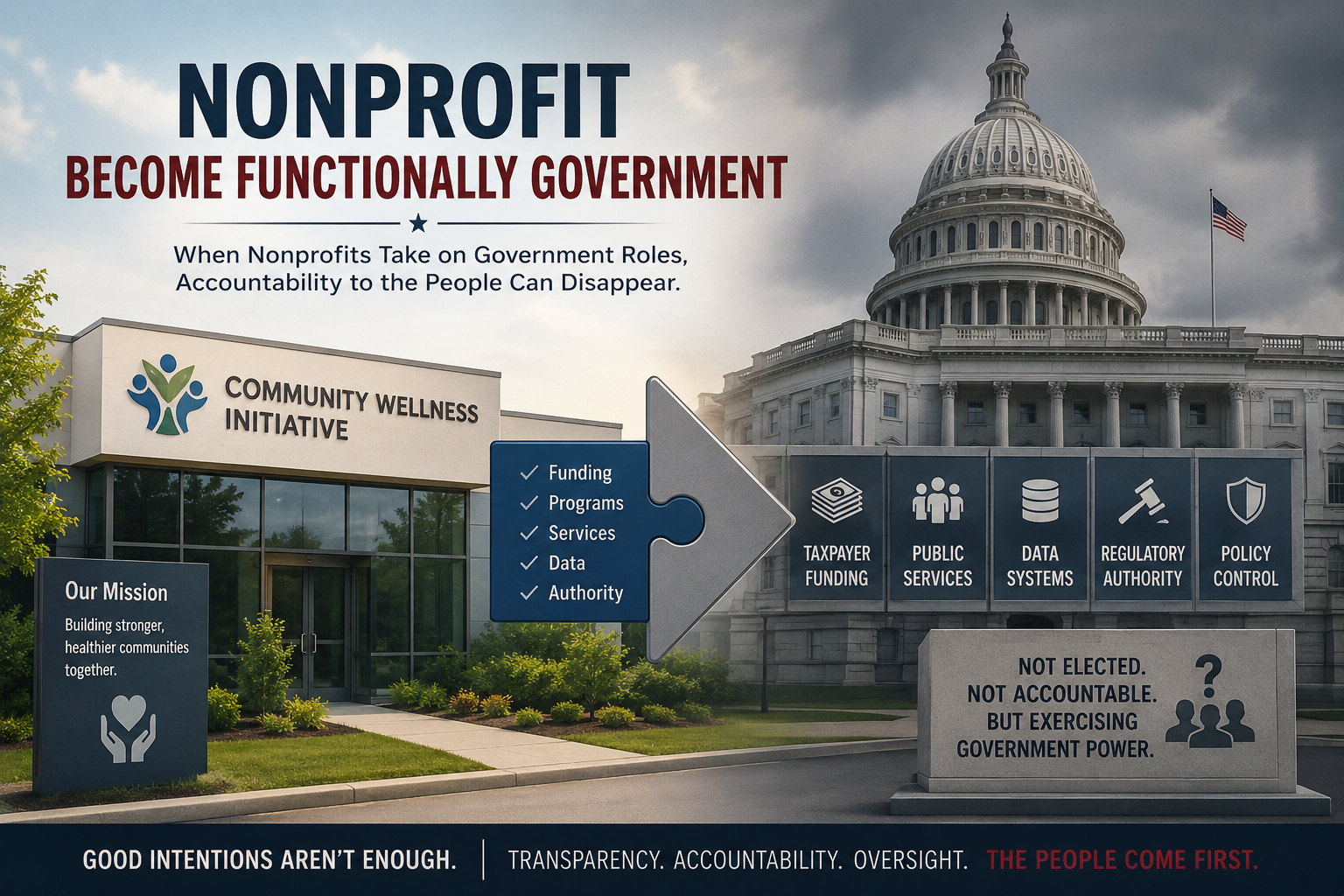
In Maryland and across the United States, nonprofit organizations increasingly perform functions that were once handled directly by government agencies. They receive public grants, administer taxpayer-funded programs, influence public policy, and in some cases operate almost entirely on government money while remaining legally private entities.
That raises a major public-interest question:
At what point does a nonprofit become so dependent on taxpayer funding that it should be subject to the same transparency rules as government agencies?
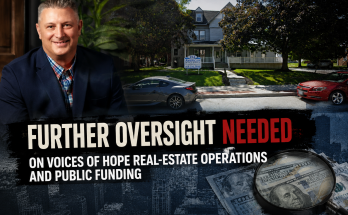
The debate becomes especially relevant when examining organizations like Voices of Hope Maryland, whose own financial disclosures indicate that the overwhelming majority of its revenue comes from government sources.
A Nonprofit Almost Entirely Funded by Taxpayers
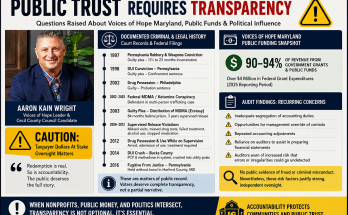
According to publicly available IRS filings and audited financial reports, Voices of Hope receives the vast majority of its funding from government grants and contracts. In some reporting periods, roughly 94% of the organization’s revenue originated from government funding streams.
That means taxpayers—not private donors—are effectively financing nearly the entire operation.
Yet despite this level of public funding, the organization still operates under the legal protections and disclosure limitations of a private nonprofit corporation rather than a public agency.
That distinction matters.
Government entities are generally subject to:
- Freedom of Information Act (FOIA) requests
- Public records laws
- Open meeting requirements
- Procurement oversight
- Public salary scrutiny
- Enhanced auditing standards
- Ethics and conflict-of-interest rules
Private nonprofits, even when heavily government-funded, often are not.
The Public Accountability Gap
This creates what critics describe as a “transparency gap.”
Taxpayers may fund nearly all operations of an organization while simultaneously having limited access to:
- Internal communications
- Detailed spending records
- Contracts
- Personnel decisions
- Oversight documentation
- Investigative findings
- Performance metrics
- Internal governance records
In practical terms, the public may be paying for the organization without receiving the same transparency rights they would have if the program were operated directly by a county or state agency.
That concern becomes more significant when nonprofits:
- perform government-like services,
- influence public policy,
- receive recurring state appropriations,
- or maintain close relationships with elected officials.
Oversight Concerns Already Raised in Audits
This issue becomes even more serious when financial audits themselves identify internal control or oversight concerns.
Voices of Hope’s publicly released audits and financial disclosures have already drawn attention because auditors noted concerns involving financial oversight and internal controls. While audits do not automatically imply wrongdoing, they are specifically designed to identify areas where accountability systems may be weak or vulnerable.
When an organization is almost entirely funded by taxpayer dollars, even routine audit findings become matters of public concern because:
- the money originates from the public,
- the services affect the public,
- and failures in oversight potentially expose public funds to misuse.
The public-interest argument for transparency becomes substantially stronger under those circumstances.
Courts Have Already Faced This Question
The legal issue itself is not new.
Courts around the country have repeatedly examined whether heavily government-funded nonprofits should be treated as “quasi-public” entities for purposes of public records laws.
Several factors are commonly considered:
- How much funding comes from government?
- Does the organization perform a governmental function?
- Does government exercise control or oversight?
- Would the function otherwise be performed by government?
- Is the organization effectively acting on behalf of the state?
Some courts have ruled that certain nonprofits can indeed be subject to public records laws when they become deeply intertwined with government operations.
Others have maintained that private corporate status shields them from full FOIA compliance, even when public funding is substantial.
The result is an inconsistent patchwork nationwide.
The “94% Question”
At some point, the distinction between “private nonprofit” and “publicly funded government proxy” becomes difficult to ignore.
If an organization receives:
- nearly all of its revenue from taxpayers,
- administers public-service programs,
- receives government grants year after year,
- partners directly with public agencies,
- and influences public policy,
many citizens reasonably ask:
Why should transparency stop simply because the organization incorporated as a nonprofit?
Critics argue that the current system can create a loophole where governments effectively outsource public functions into private structures that avoid the accountability obligations government agencies normally face.
Supporters of nonprofits counter that additional disclosure burdens could hinder operations, expose sensitive client information, and discourage organizations from partnering with government.
But as public funding levels rise, the pressure for increased transparency rises with it.
Why This Matters Beyond One Organization
This issue extends far beyond Voices of Hope.
Across the country, nonprofit organizations now manage:
- addiction recovery programs,
- homelessness initiatives,
- violence intervention efforts,
- public health services,
- housing programs,
- workforce development,
- and criminal justice diversion programs.
Many of these organizations operate with budgets funded overwhelmingly by taxpayers.
As that trend continues, the line between “private nonprofit” and “public institution” becomes increasingly blurred.
The core issue is not whether nonprofits do valuable work.
The issue is whether organizations that are almost entirely taxpayer-funded should be allowed to operate with substantially less transparency than the government agencies funding them.
That debate is likely to intensify as nonprofit budgets continue to grow and public scrutiny over government spending increases.
Because ultimately, when taxpayers fund nearly the entire operation, many believe the public has a right to see more than just annual summaries and limited disclosures.
They believe the public has a right to full accountability.