In communities struggling with addiction, recovery nonprofits often become pillars of hope, advocacy, and public investment. They receive taxpayer dollars, shape local policy discussions, and are frequently viewed as beyond criticism because of the emotionally sensitive work they perform.
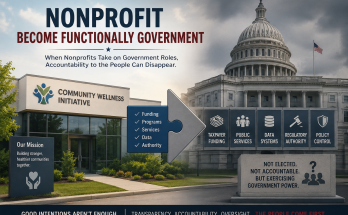
But transparency advocates warn that public sympathy should never replace oversight — especially when nonprofits become intertwined with politics, government funding, and leadership figures with extensive criminal histories.
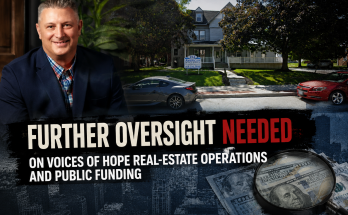
Those concerns are now surfacing in Cecil County as Aaron Wright, a senior figure connected to Voices of Hope Maryland, seeks elected office while publicly presenting a simplified version of a far more extensive criminal background documented in court records and federal filings.
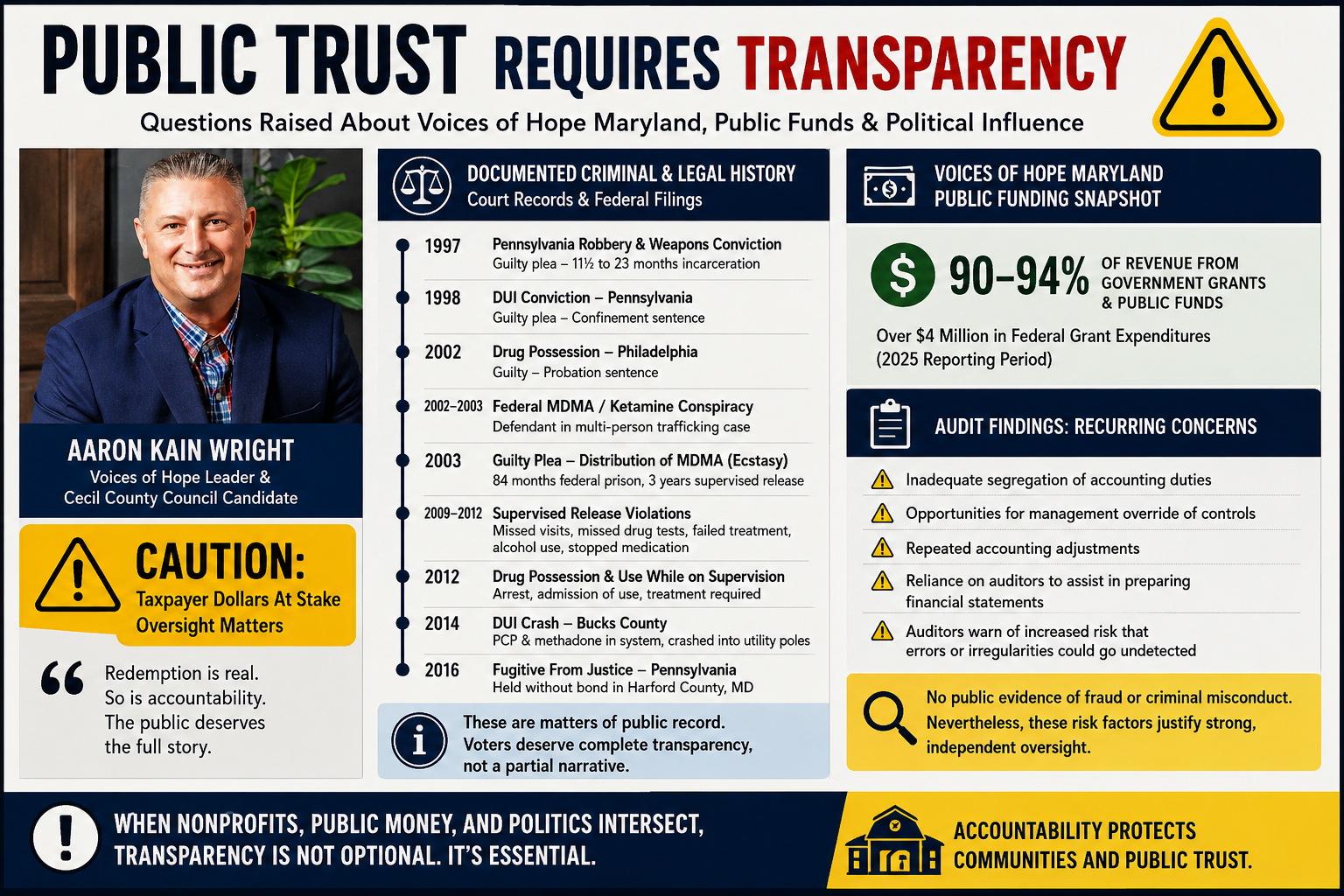
Public records reviewed across Pennsylvania, Maryland, and federal court systems show a decades-long history involving robbery convictions, weapons charges, drug offenses, federal narcotics trafficking, supervised-release violations, fugitive proceedings, addiction relapse, and later DUI-related incidents.
Among the most serious cases was a federal prosecution in the Eastern District of Pennsylvania, where Wright was identified as a defendant in a multi-person MDMA and ketamine trafficking conspiracy. Federal records summarized in the court timeline show Wright ultimately pled guilty to MDMA distribution and received an 84-month federal prison sentence followed by supervised release.
Supervision records later documented missed probation appointments, missed drug testing, mental-health treatment failures, alcohol-related incidents, and later drug-related violations while still under federal supervision.
Years later, Bucks County court records and reporting documented another incident involving a DUI crash in which prosecutors reportedly stated PCP and methadone were present in Wright’s system after he crossed into oncoming traffic and struck utility poles.
Eventually, Wright entered the recovery community and became involved with Voices of Hope Maryland, later rising into nonprofit leadership and public advocacy roles. Public biographies emphasize redemption, addiction recovery, homelessness, and rebuilding his life through peer-support work.
But critics argue the issue is no longer simply personal redemption.
The concern now centers on institutional power, taxpayer money, and public accountability.
Voices of Hope’s audited financial filings show the organization has rapidly expanded into a multimillion-dollar operation heavily dependent on public funding. Audit records show approximately 90–94% of organizational revenue came from government grants and public agencies.
Federal award expenditures exceeded roughly $4 million in the 2025 reporting period alone, much of it tied to opioid-response and recovery initiatives.
Although auditors repeatedly issued unmodified opinions finding no material federal grant noncompliance, the same audits also documented recurring internal-control concerns over multiple years. These included inadequate segregation of accounting duties, opportunities for management override of controls, repeated accounting adjustment issues, and reliance on external auditors to assist in preparing financial statements.
Auditors specifically warned that the organization’s structure increased the risk that “errors or irregularities could occur and not be detected.”
Importantly, none of the audit findings establish fraud or criminal misconduct by Voices of Hope. No public evidence currently shows theft, embezzlement, or misuse of grant money.
Still, governance experts often view certain combinations of factors as legitimate public-interest warning signs:
- rapid nonprofit growth,
- heavy taxpayer dependence,
- political relationships,
- weak internal controls,
- emotionally insulated missions,
- and leadership tied to extensive criminal histories.
Recovery nonprofits can become especially difficult to scrutinize because criticism is often framed as hostility toward addiction recovery itself. That dynamic can discourage aggressive oversight even when millions in public funds are involved.
The controversy becomes even more significant when nonprofit leadership intersects with electoral politics.
As Aaron Wright campaigns for Cecil County Council while connected to a publicly funded nonprofit organization, questions naturally arise about whether political influence, county relationships, grant access, or public funding decisions could eventually overlap.
Those questions do not mean people with criminal records are incapable of change. Nor do they prove wrongdoing by Voices of Hope or its staff.
But public accountability advocates argue voters deserve the full picture — not just the redemption narrative.
In the end, the issue may not be whether recovery is real. The issue is whether transparency, oversight, and institutional safeguards are strong enough to ensure public trust is justified.
Source Documents:
Aaron Wright Rap sheet Summary
Aaron Wrights wife Court records of theft ring over $10k
Voices Of Hope Financials (minus the past 2 years)